32 private links
This interaction could help explain both why quantum processes can occur within environments like the brain and why we lose consciousness under anesthesia.

The paper “The black hole interior from non-isometric codes and complexity” by Akers, Engelhardt, Harlow, Penington, and Vardhan (JHEP06(2024)155) does make a credible claim to resolve all three components of the black hole information problem in a unified framework.
The Three Paradoxes Resolved:
-
Finite black hole entropy (as required by Bekenstein-Hawking entropy),
-
Unitarity of black hole evaporation (consistent with the Page curve),
-
Semiclassical effective field theory validity inside the horizon (to explain the interior modes and entanglement).
Hawking's original argument was that you can't have all three simultaneously. This paper proposes a non-isometric holographic map (i.e. not preserving inner products globally) that still behaves as if it were isometric for all sub-exponential complexity observables. In effect:
Null states (states mapped to zero) exist but are exponentially complex and thus undetectable by any reasonable observer.
This allows the interior to emerge via quantum error correction (though not isometrically) and maintains consistency with both the Page curve and unitary dynamics.
This paper is a strong candidate for what Harlow refers to when he mentions resolving all three paradoxes of the black hole information problem.
Abstract page for arXiv paper 2502.17575: On the quantum mechanics of entropic forces

For the first time, scientists have measured the shape of an electron in solids, opening the door to advances in quantum materials.
Prior measurements of the spins of quarks that make up protons and neutrons find these characteristics contribute no more than around 30 percent of the nucleon's total spin, leading to the so-called spin crisis.
Quantum entanglement is where two particles become interconnected and share a single state. But how and when do particles become entangled?

“When it becomes accepted that the mind is a quantum phenomenon, we will have entered a new era in our understanding of what we are,” he says.
a drug binding to microtubules delayed unconsciousness in rats under anesthesia.
A silent symphony is playing inside your brain right now as neurological pathways synchronize in an electromagnetic chorus that's thought to give rise to consciousness.
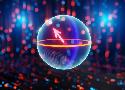
Shrinking this down to just 1 qubit is therefore a significant advance. Goswami and co exploit a way of representing the state space of a quantum system as a geometric globe, known as a Bloch sphere. They then represent the location of cities as quantum states on a Bloch sphere. So the process of travelling from one city to the next can be achieved through a series of rotations of the sphere.
In fact, it is possible for the sphere to represent the routes from each city to all the others by the process of superposition. “We use the superposition of states to travel through multiple paths at once,” they say. It is then possible to select the optimal route by through the appropriate measurement of the quantum state.
“They are bridging quantum and classical time,” says Basil Altaie at the University of Leeds in the UK. The fact that the researchers studied a concrete and specific system and came up with a variable that matches conventional time may even mean that the only way we should be thinking about time is as arising from quantumness, he says
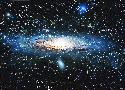
A new definition of time suggests that what we once thought was a fundamental element of reality is actually just a byproduct.
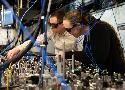
Microsoft and Quantinuum say they've developed the most error-free quantum computing system yet.

Our physical, 3D world consists of just two types of particles: bosons, which include light and the famous Higgs boson; and fermions—the protons, neutrons, and electrons that comprise all the "stuff," present company included.
If the fractional quantum Hall regime were a series of highways, these highways would have either two or four lanes. The flow of the two-flux or four-flux composite fermions, like automobiles in this two- to four-flux composite fermion traffic scenario, naturally explains the more than 90 fractional quantum Hall states that form in a large variety of host materials. Physicists at Purdue University have recently discovered, though, that fractional quantum Hall regimes are not limited to two-flux or four-flux and have discovered the existence of a new type of emergent particle, which they are calling six-flux composite fermion.
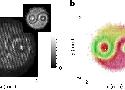
In classical optics, however, there is another way to reconstruct a 3D object. This is called digital holography, and is based on recording a single image, called interferogram, obtained by interfering the light scattered by the object with a reference light.
The team, led byEbrahim Karimi, Canada Research Chair in Structured Quantum Waves, co-director of uOttawa Nexus for Quantum Technologies (NexQT) research institute and associate professor in the Faculty of Science, extended this concept to the case of two photons.
Reconstructing a biphoton state requires superimposing it with a presumably well-known quantum state, and then analyzing the spatial distribution of the positions where two photons arrive simultaneously. Imaging the simultaneous arrival of two photons is known as a coincidence image. These photons may come from the reference source or the unknown source. Quantum mechanics states that the source of the photons cannot be identified.
Dr. Alessio D'Errico, a postdoctoral fellow at the University of Ottawa and one of the co-authors of the paper, highlighted the immense advantages of this innovative approach, "This method is exponentially faster than previous techniques, requiring only minutes or seconds instead of days. Importantly, the detection time is not influenced by the system's complexity—a solution to the long-standing scalability challenge in projective tomography."
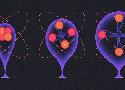
Several groups, including van Kolck’s, plan to repeat Bacca’s calculations and find out what went wrong. It’s possible that simply including more terms in the approximation of the nuclear force might be the answer. On the other hand, it’s also possible that these ballooning helium nuclei have exposed a fatal flaw in our understanding of the nuclear force.
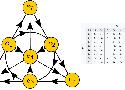
Quaternions are fundamentally non-commutative, and explain why rotating a three-dimensional object about one axis and then another gives you a different final state than rotating that same object about the same two axes, but in the opposite order.
we observe only one point in the distribution, because that's the most likely outcome. that spreads most in the environment, for example ending up with the most photons hitting our eyes.
"But there’s a second condition that a quantum property must meet to be observed. Although immunity to interaction with the environment assures the stability of a pointer state, we still have to get at the information about it somehow. We can do that only if it gets imprinted in the object’s environment. When you see an object, for example, that information is delivered to your retina by the photons scattering off it. They carry information to you in the form of a partial replica of certain aspects of the object, saying something about its position, shape and color. Lots of replicas are needed if many observers are to agree on a measured value — a hallmark of classicality. Thus, as Zurek argued in the 2000s, our ability to observe some property depends not only on whether it is selected as a pointer state, but also on how substantial a footprint it makes in the environment. The states that are best at creating replicas in the environment — the “fittest,” you might say — are the only ones accessible to measurement. That’s why Zurek calls the idea quantum Darwinism."
"One of the most remarkable ideas in this theoretical framework is that the definite properties of objects that we associate with classical physics — position and speed, say — are selected from a menu of quantum possibilities in a process loosely analogous to natural selection in evolution: The properties that survive are in some sense the “fittest.” As in natural selection, the survivors are those that make the most copies of themselves. This means that many independent observers can make measurements of a quantum system and agree on the outcome — a hallmark of classical behavior."
but it's all so natural, of course
"Riedel says we could hardly expect otherwise, though: In his view, QD is really just the careful and systematic application of standard quantum mechanics to the interaction of a quantum system with its environment. Although this is virtually impossible to do in practice for most quantum measurements, if you can sufficiently simplify a measurement, the predictions are clear, he said: “QD is most like an internal self-consistency check on quantum theory itself.”
we're all Bayesians now
"This experiment therefore shows that, at least for local models of quantum mechanics, we need to rethink our notion of objectivity. The facts we experience in our macroscopic world appear to remain safe, but a major question arises over how existing interpretations of quantum mechanics can accommodate subjective facts.
Some physicists see these new developments as bolstering interpretations that allow more than one outcome to occur for an observation, for example the existence of parallel universes in which each outcome happens. Others see it as compelling evidence for intrinsically observer-dependent theories such as Quantum Bayesianism, in which an agent's actions and experiences are central concerns of the theory."