32 private links
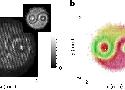
In classical optics, however, there is another way to reconstruct a 3D object. This is called digital holography, and is based on recording a single image, called interferogram, obtained by interfering the light scattered by the object with a reference light.
The team, led byEbrahim Karimi, Canada Research Chair in Structured Quantum Waves, co-director of uOttawa Nexus for Quantum Technologies (NexQT) research institute and associate professor in the Faculty of Science, extended this concept to the case of two photons.
Reconstructing a biphoton state requires superimposing it with a presumably well-known quantum state, and then analyzing the spatial distribution of the positions where two photons arrive simultaneously. Imaging the simultaneous arrival of two photons is known as a coincidence image. These photons may come from the reference source or the unknown source. Quantum mechanics states that the source of the photons cannot be identified.
Dr. Alessio D'Errico, a postdoctoral fellow at the University of Ottawa and one of the co-authors of the paper, highlighted the immense advantages of this innovative approach, "This method is exponentially faster than previous techniques, requiring only minutes or seconds instead of days. Importantly, the detection time is not influenced by the system's complexity—a solution to the long-standing scalability challenge in projective tomography."
