32 private links
The paper “The black hole interior from non-isometric codes and complexity” by Akers, Engelhardt, Harlow, Penington, and Vardhan (JHEP06(2024)155) does make a credible claim to resolve all three components of the black hole information problem in a unified framework.
The Three Paradoxes Resolved:
-
Finite black hole entropy (as required by Bekenstein-Hawking entropy),
-
Unitarity of black hole evaporation (consistent with the Page curve),
-
Semiclassical effective field theory validity inside the horizon (to explain the interior modes and entanglement).
Hawking's original argument was that you can't have all three simultaneously. This paper proposes a non-isometric holographic map (i.e. not preserving inner products globally) that still behaves as if it were isometric for all sub-exponential complexity observables. In effect:
Null states (states mapped to zero) exist but are exponentially complex and thus undetectable by any reasonable observer.
This allows the interior to emerge via quantum error correction (though not isometrically) and maintains consistency with both the Page curve and unitary dynamics.
This paper is a strong candidate for what Harlow refers to when he mentions resolving all three paradoxes of the black hole information problem.

Abstract page for arXiv paper 2502.17575: On the quantum mechanics of entropic forces
Astronomers believe about one or two supernovae—or possibly at a rate even lower than that—occur each century in galaxies like the Milky Way, but the good news is there are only two nearby stars which could go supernova within the next million years or so: Antares and Betelgeuse.
However, both of these are more than 500 light-years away from us and computer simulations have previously suggested a supernova at that distance from Earth likely wouldn't affect our planet.

Dark matter continues to confound us, so far defying every attempt to decipher it.
irreversible processes were missing one factor. Once they incorporate this factor, then these equations also do not distinguish between the future and the past anymore

For the first time, scientists have measured the shape of an electron in solids, opening the door to advances in quantum materials.

Scientists with the U.S. Department of Energy say an object once predicted only in theory has now been captured in 3D X-ray images.
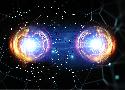
Quantum entanglement is where two particles become interconnected and share a single state. But how and when do particles become entangled?

The agreement between theoretical predictions and experimental data means that, using the parton model and data from the high-energy region, it has been possible for the first time to reproduce the behavior of atomic nuclei so far explained solely by nucleonic description and data from low-energy collisions. The results of the described studies open up new perspectives for a better understanding of the structure of the atomic nucleus, unifying its high- and low-energy aspects.

Researchers have demonstrated that cold atoms can be used to simulate gravitational waves in a laboratory setting. When two black holes collide, they send ripples through space and time, much like waves spreading across a pond. These ripples, known as gravitational waves, were first predicted by Ei

Professors Andreas Crivellin of the University of Zurich and Bruce Mellado of the University of the Witwatersrand and iThemba LABS in South Africa have documented deviations in the way particles interact. These deviations are inconsistent in comparison to the way they are expected to break up, and point to the existence of new bosons.

When researchers arranged the particles discovered in the middle part of the 20th century, using charge and strangeness as organizing parameters, the result was geometrical patterns. These patterns were explained by invoking the existence of quarks. Different combinations of the up, down, and strange quarks generated the geometrical patterns.

The inventor of a propellantless propulsion drive, which he claims uses an unknown force called the 'Exodus Effect,' is ready to go to space.

We finally know what brought light to the dark and formless void of the early Universe.
“They are bridging quantum and classical time,” says Basil Altaie at the University of Leeds in the UK. The fact that the researchers studied a concrete and specific system and came up with a variable that matches conventional time may even mean that the only way we should be thinking about time is as arising from quantumness, he says

A new definition of time suggests that what we once thought was a fundamental element of reality is actually just a byproduct.
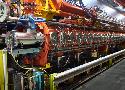
There's a specter haunting the tunnels of a particle accelerator at CERN.
It's described as taking place in phase space, which can represent one or more states of a moving system. Since four states are required to represent the structure, the researchers view it as four-dimensional.

Our physical, 3D world consists of just two types of particles: bosons, which include light and the famous Higgs boson; and fermions—the protons, neutrons, and electrons that comprise all the "stuff," present company included.

If the fractional quantum Hall regime were a series of highways, these highways would have either two or four lanes. The flow of the two-flux or four-flux composite fermions, like automobiles in this two- to four-flux composite fermion traffic scenario, naturally explains the more than 90 fractional quantum Hall states that form in a large variety of host materials. Physicists at Purdue University have recently discovered, though, that fractional quantum Hall regimes are not limited to two-flux or four-flux and have discovered the existence of a new type of emergent particle, which they are calling six-flux composite fermion.