32 private links
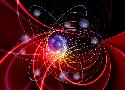
Dark matter might have its own force, mediated by dark photons similar to the way electromagnetism is mediated by photons. A new study shows that not only are dark photons consistent with experiments in particle physics, they could also solve the g-2 anomaly for muons.
Experimentally, g-2 = 0.00233184121. Theoretical calculations put g-2 = 0.00233183620. This is known as the g-2 anomaly and is beyond irksome. If you include dark photon interactions, the theoretical result becomes g-2 = 0.00233183939, which is significantly better. Overall, the dark photon model is preferred over the standard model at 6.5 sigma, which is a very strong result.


antihydrogen gravitation is the same as that of hydrogen, it falls downwards rather than rising, within the uncertainty limits of the experiment.
This means our research has empirically ruled out a number of historical theories involving so-called “anti-gravity” suggesting that antimatter would gravitate in exactly the opposite direction as normal matter.
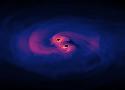
Newton thought that gravitation would happen instantly, propagating at infinite speeds. Einstein showed otherwise; gravity isn't instant.

If confirmed, this would represent arguably one of the biggest scientific breakthroughs for a hundred years, since Einstein's theories of relativity. That is because a fifth force and any particles associated with it are not part of the Standard Model of particle physics.
Researchers know that there is what they describe as "physics beyond the Standard Model" out there, because the current theory can't explain lots of things that astronomers observe in space.
These include the fact that galaxies are continuing to accelerate apart after the Big Bang that created the Universe, rather than the expansion slowing down. Scientists say the acceleration is being driven by an unknown force, called dark energy.
Galaxies are also spinning faster than they should, according to our understanding of how much material is in them. Researchers believe it's because of invisible particles called dark matter, which again are not part of the Standard Model.
"the flat universe remains the leading model of our cosmic surroundings"
Scientists think the universe is flat, but new observations suggest that we might actually be living in a gigantic sphere. Whoa.
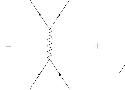
In current quantum field theory, causality is typically defined by the vanishing of field commutators for spacelike separations. Two researchers at the University of Massachusetts and Universidade Federal Rural in Rio de Janeiro have recently carried out a study discussing and synthesizing some of the key aspects of causality in quantum field theory. Their paper, published in Physical Review Letters, is the result of their investigation of a theory of quantum gravity commonly referred to as "quadratic gravity."
One of the great counterintuitive puzzles of quantum mechanics is wave-particle duality. This is the phenomenon in which objects behave both like particles and like waves. Numerous experiments have shown that a single particle—an electron or a photon, for example—can interfere with itself, like a wave. The double slit experiment, in which a particle passes…
"So all signs point to the boson being the carrier of some new, fifth force. But physics isn't keen on celebrating prematurely. Finding a new particle is always big news in physics, and warrants a lot of scrutiny. Not to mention repeated experiment."
Everything in our Universe is held together or pushed apart by four fundamental forces: gravity, electromagnetism, and two nuclear interactions. Physicists now think they've spotted the actions of a fifth physical force emerging from a helium atom.
After decades of miniaturization, the electronic components we've relied on for computers and modern technologies are now starting to reach fundamental limits. Faced with this challenge, engineers and scientists around the ...
“Time Is Out of Joint:” Consciousness, Temporality, and Probability in Quantum Theory | SpringerLink
While the juncture of reality, causality, and probability is a familiar feature of foundational discussions concerning quantum theory, this article considers the role of consciousness and temporality...
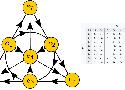
Quaternions are fundamentally non-commutative, and explain why rotating a three-dimensional object about one axis and then another gives you a different final state than rotating that same object about the same two axes, but in the opposite order.
Astronomers are puzzling over a paucity of planets in the galaxy measuring between 1.5 and two times Earth's size.
we observe only one point in the distribution, because that's the most likely outcome. that spreads most in the environment, for example ending up with the most photons hitting our eyes.
"But there’s a second condition that a quantum property must meet to be observed. Although immunity to interaction with the environment assures the stability of a pointer state, we still have to get at the information about it somehow. We can do that only if it gets imprinted in the object’s environment. When you see an object, for example, that information is delivered to your retina by the photons scattering off it. They carry information to you in the form of a partial replica of certain aspects of the object, saying something about its position, shape and color. Lots of replicas are needed if many observers are to agree on a measured value — a hallmark of classicality. Thus, as Zurek argued in the 2000s, our ability to observe some property depends not only on whether it is selected as a pointer state, but also on how substantial a footprint it makes in the environment. The states that are best at creating replicas in the environment — the “fittest,” you might say — are the only ones accessible to measurement. That’s why Zurek calls the idea quantum Darwinism."
"One of the most remarkable ideas in this theoretical framework is that the definite properties of objects that we associate with classical physics — position and speed, say — are selected from a menu of quantum possibilities in a process loosely analogous to natural selection in evolution: The properties that survive are in some sense the “fittest.” As in natural selection, the survivors are those that make the most copies of themselves. This means that many independent observers can make measurements of a quantum system and agree on the outcome — a hallmark of classical behavior."
but it's all so natural, of course
"Riedel says we could hardly expect otherwise, though: In his view, QD is really just the careful and systematic application of standard quantum mechanics to the interaction of a quantum system with its environment. Although this is virtually impossible to do in practice for most quantum measurements, if you can sufficiently simplify a measurement, the predictions are clear, he said: “QD is most like an internal self-consistency check on quantum theory itself.”
the 'puzzle' of how parts fit with an overall whole presumes clear-cut spatial boundaries among underlying components, yet spatial nonlocality cautions against this view. Temporal nonlocality further complicates this picture: how does one describe an entity whose constituent parts are not even coexistent?