32 private links

Total billionaire wealth in the EU reached €2.4 trillion by late November, exceeding Italy's entire GDP of €2.2 trillion and approaching France's €2.9 trillion economy, a new Oxfam report found.

There are many excuses for failing to tax the ultra-wealthy. The truth is that governments don’t tackle the problem because they don’t want to, says Guardian columnist George Monbiot
One such study, conducted by Lee Epstein of Washington University in St. Louis and Mitu Gulati of the University of Virginia, concluded that over the century ending in 2021 the court ruled for businesses an average of 41 percent of the time. But the court led by Chief Justice John G. Roberts Jr. since 2005 decided for businesses 63 percent of the time.
The study showed a growing partisan divide between the justices. In 1953, the study’s authors wrote, “Democratic and Republican appointees are statistically indistinguishable, deciding on average about 45 percent of the cases in favor of the rich.” By 2022, they wrote, “that share is about 70 percent for the average Republican justice and 35 percent for the average Democratic justice.”
If the income share of the
top 20 percent (the rich) increases, then GDP growth actually declines over the medium term,
suggesting that the benefits do not trickle down. In contrast, an increase in the income share of the
bottom 20 percent (the poor) is associated with higher GDP growth

Tax cuts for the wealthy didn't boost the economies of the U.S. and 17 other countries — but they did worsen income inequality.
"Based on our research, we would argue that the economic rationale for keeping taxes on the rich low is weak," Julian Limberg, a co-author of the study and a lecturer in public policy at King's College London, said in an email to CBS MoneyWatch. "In fact, if we look back into history, the period with the highest taxes on the rich — the postwar period — was also a period with high economic growth and low unemployment."
Already, Mr. Trump's tax cuts have lifted the fortunes of the ultra-rich, according to 2019 research from two prominent economists, Emmanuel Saez and Gabriel Zucman of the University of California at Berkeley. For the first time in a century, the 400 richest American families paid lower taxes in 2018 than people in the middle class, the economists found.
Only about half the U.S. population is invested in the stock market through their retirement and savings accounts, and even then more than 80% of all stocks are owned by the richest 10%.
For tax years 1944 through 1951, the highest marginal tax rate for individuals was 91%, increasing to 92% for 1952 and 1953, and reverting to 91% 1954 through 1963.
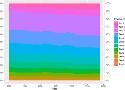
fully 40% of total U.S. emissions were associated with income flows to the highest earning 10% of households. Among the highest earning 1% of households (whose income is linked to 15–17% of national emissions) investment holdings account for 38–43% of their emissions
"the wealth tax is likely to be the most direct and powerful tool to restore tax progressivity at the very top of the distribution"
"our analysis shows that the wealth tax has great revenue and wealth equalizing
potential in the US context. The wealth tax, if the tax rates are high enough, is also a powerful tool to deconcentrate wealth. A wealth tax of 2 or 3% per year can put a significant dent into this growth rate advantage. With successful enforcement, a wealth tax has to deliver either revenue or de-concentrate wealth.79 Set the rates low (1%) and you get revenue in perpetuity but little (or very slow) de-concentration. Set the rates medium (2-3%) and you get revenue for quite a while and de-concentration eventually. Set the rates high (significantly above 3%) and you get de-concentration fast but revenue does not last long. Which is best will depend of course on ones political views."
"Can a wealth tax be successfully enforced? Our review of past and foreign experiences, as well as recent empirical work tells us that enforcement is a policy choice."
"The wealth tax accelerates the process of dispersion of stock ownership for very successful businesses that make their owners-founders billionaires. Dispersed stock ownership has been a feature of US capitalism and is a key reason why taxing wealthy business owners is feasible. Importantly and in contrast to labor income, this dispersion does not mean that economic activity disappears. There might not be even any effect on the wealth stock if the government uses the wealth tax proceeds for public investment, debt reduction, or to create a sovereign fund. The wealth disappears only if the government cannot save the money and cannot encourage middle class saving."


"our democracy is a democracy in name only"
likelihood of policy passing insensitive to public support, but very sensitive to support by economic elites and interest groups