32 private links
Alexander Dugin, the fascist philosopher known as “Putin’s Rasputin”, said: “The capture of Maduro demonstrates that international law no longer exists — only the law of force applies.”
Alexey Pushkov, a Russian senator, accused the US of returning the world to “the savage imperialism of the 19th century”, adding: “Won’t the ‘triumph’ turn into a disaster?”
“The United States carried out a coup in Venezuela, struck the country, and demonstrated that international law means nothing to a nation that considers itself a hegemon,” said Igor Girkin, a former soldier and FSB officer turned commentator.
According to Michael Kofman, a Russian military analyst at the Carnegie Endowment for International Peace, the Trump administration’s decision to strike Venezuela without even the “veneer of justification” “substantially frays” any sense of international order.
He adds that it “will make it much harder in the future for the US to convince other states that this type of behaviour should be punished”.
“By using force to assert its hegemony in the Western Hemisphere, the US is trading these short-term gains for a long-term structural cost to its overall position in the international system and to the advantages it enjoys over its rivals Russia and China,” he said.
The statements by the two men amount to an explicit declaration of gunboat diplomacy and an embrace of the kind of 19th-century U.S. imperialist policy in the Western Hemisphere that has been widely criticized across Latin America.
Senator Mark Warner of Virginia, the top Democrat on the Senate Intelligence Committee, said in an interview that decades-long efforts by the United States to prove it is not a colonial power in the Americas has been “all thrown out” now, and that Mr. Trump’s actions could “potentially turn the whole region against us.”
He added that the administration’s aim of dominating the Western Hemisphere — including forcibly seizing leaders in the region — could spur China and Russia to try to do the same in their perceived “spheres of influence.”
That’s why, long after the shock has worn off, the enduring lesson for China will be a sense of vindication. Operation Absolute Resolve is a confirmation of what the CCP has always believed — that there is no such thing as a rules-based international order; that it’s a jungle out there.
Now Beijing will feel vindicated that America has shed the pretence. Whether Trump’s actions are the death knell of the rules-based world order, or merely reveal that it never existed, doesn’t truly matter. What matters is that the US and China, as the two most powerful nations on Earth, the two countries with the most capability to uphold the rules for everyone else, share a disdain for them. Like the fairies of Neverland, these laws only ever existed if they were believed in.
The world order as we knew it has been overturned.
By seizing a sitting head of state and announcing direct American administration over a sovereign country – without international authorisation, coalition partners or even the language of temporariness – he crossed a boundary the post-1945 international system was meant to keep intact.
It’s true that air strikes are generally more accurate now than they were during the war in Indochina, so in theory, at least, unidentified targets should be hit less frequently and civilian casualties should be lower. Nonetheless, civilian deaths have been the norm during the Iraq and Afghanistan campaigns, as they were during the bombing of Lebanon by Israeli forces over the summer. As in Cambodia, insurgencies are the likely beneficiaries. To cite one example, on January 13 of this year an aerial strike by a US Predator drone on a village in a border area of Pakistan killed eighteen civilians, including five women and five children. The deaths undermined the positive sentiments created by the billions of dollars in aid that had flowed into that part of Pakistan after the massive earthquake months earlier. The question remains: is bombing worth the strategic risk?
If the Cambodian experience teaches us anything, it is that miscalculation of the consequences of civilian casualties stems partly from a failure to understand how insurgencies thrive. The motives that lead locals to help such movements don’t fit into strategic rationales like the ones set forth by Kissinger and Nixon. Those whose lives have been ruined don’t care about the geopolitics behind bomb attacks; they tend to blame the attackers. The failure of the American campaign in Cambodia lay not only in the civilian death toll during the unprecedented bombing, but also in its aftermath, when the Khmer Rouge regime rose up from the bomb craters, with tragic results. The dynamics in Iraq could be similar.
Storming into Gaza will fulfill Hamas’s wish.
Unfortunately, in the efforts to eliminate Hamas, which cannot be done by force, and to ensure that such a threat can never be allowed to reemerge, which is equally impossible so long as the occupation continues, Israel seems ready to jump right into the briar patc

One fundamental way this double standard operates is through a false equivalence, a two-sides-ism that hides the massive asymmetry of power between the state of Israel and the scattered population groupings that make up the Palestinian people. They’re not equal. One dominates while the other is dominated. One colonizes. The other is colonized.
“I was in those meetings, and Gorbachev has [also] said there was no promise not to enlarge NATO,” Zoellick recalls. Soviet Foreign Minister, Eduard Shevardnadze, later president of Georgia, concurred, he says. Nor does the treaty on Germany’s unification include a limit on NATO enlargement.
“It’s always hard to know who owns the success,” an official said. “Sometimes for us, success is moving the needle with other bigger players and getting them to think about things. So if the U.S. advanced a version of our idea, sometimes that’s what success looks like for us.”
Some poor countries struggling to repay China now find themselves stuck in a kind of loan limbo: China won’t budge in taking losses, and the IMF won’t offer low-interest loans if the money is just going to pay interest on Chinese debt.
Ukraine’s forces have lost a large share of their most experienced soldiers, having suffered an estimated 120,000 casualties. Purportedly leaked US intelligence documents have suggested that the counteroffensive could fall “well short” of Kyiv’s goals.
Yet Ukraine’s army has been underestimated before, such as when it defied western military assessments last year and pushed back Russian forces from around the capital and then the northeastern city of Kharkiv. Russia has also lost almost twice as many men since the full-scale invasion, according to western assessments. Moreover, Ukrainian troops are better equipped and trained than their foes.
“If the Ukrainian attack is hard and fast and gets behind the Russians, the frontline will unravel and the Russians will run . . . just as they did during the counter-offensive around Kharkiv,” said Glen Grant, a former British army officer and adviser to the Ukrainian parliament’s defence committee.
The loss of Kherson will spark a fresh round of recriminations inside Russia as supporters of the invasion and regime officials search for guilty parties to blame for the debacle. The mood among regime loyalists and hardliners is already dark. Former Kremlin advisor Sergei Markov branded the decision to leave Kherson, “Russia’s biggest geopolitical defeat since the collapse of the USSR.”


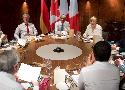
the United States is no longer able or willing to carry the whole load. The sharing of burdens will be essential if democracies are to remain united in the pursuit of common interests and in the face of common threats.
Uniting the democratic world against the clear and present danger of rising authoritarianism is not an act of idealism but of realism. China and Russia already hold similar interests and perceive similar threats, such that they are inclined to view the world in terms of “us versus them.” To convene a summit of democracies will not therefore drive authoritarian states together so much as it will acknowledge the stark reality of a world bifurcated into authoritarian and democratic camps. The project of supporting democracies and advancing democratic values, in this context, is continuous with past U.S. policy.
The idea of a democracy summit is not new, but the need for one has never been greater. Together, the world’s democracies can devise cooperative solutions to their most vexing domestic problems by collectively addressing such shared issues as demographic shifts, social polarization, and growing inequality. Such shared efforts will make democracies more internally cohesive and collectively resilient.
At the same time, democracies can help protect one another against external attacks, including those that take the form of information warfare or economic coercion. Democracies must deter bad actors from interfering in their internal affairs by making clear that those who seek to exploit the openness of democracies by sowing discord will face reciprocal responses. Forewarned in this fashion, authoritarian states will accept the new ground rules, and all powers will benefit from the elimination of one area of increasingly serious conflict.
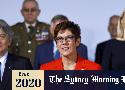
Europe is also increasingly concerned about the future of Taiwan after Beijing imposed new national security laws on Hong Kong, increased its military presence in the Taiwan strait and released a stream of propaganda videos preparing the Chinese public for a potential invasion.
The Chinese Communist Party reinserted the word “peaceful” in its desire to unify with Taiwan through its Five Year Plan last week, after omitting it in May.

"In a sense, the leaked Iranian cables provide a final accounting of the 2003 United States invasion of Iraq. The notion that the Americans handed control of Iraq to Iran when they invaded now enjoys broad support, even within the United States military. A recent two-volume history of the Iraq War, published by the United States Army, details the campaign’s many missteps and its “staggering cost” in lives and money. Nearly 4,500 American troops were killed, hundreds of thousands of Iraqis died and American taxpayers spent up to $2 trillion on the war. The study, which totals hundreds of pages and draws on declassified documents, concludes: “An emboldened and expansionist Iran appears to be the only victor.”