32 private links

“when you think of it, we shouldn't even have an election.”


In Peru, there are people aged 70 or 80, who have lived their entire lives under the quasi-feudal servitude of large estates, or gamonales. Not being able to read, they were denied the right to vote until 1980. They have faced violence and repression when fighting for land rights. They have survived hyperinflation, a cholera epidemic, terrorism, dictatorship, racism, hunger, at least two transitions to democracy, a poorly handled pandemic that killed about 220,000 people. (Peru had the highest covid mortality rate in the world.) Add on top of that a nearly permanent political crisis, with six presidents cycling through in the past six years.
Twitter admits bias in algorithm for rightwing politicians and news outlets | Twitter | The Guardian
Home feed promotes rightwing tweets over those from the left, internal research finds





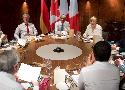
the United States is no longer able or willing to carry the whole load. The sharing of burdens will be essential if democracies are to remain united in the pursuit of common interests and in the face of common threats.
Uniting the democratic world against the clear and present danger of rising authoritarianism is not an act of idealism but of realism. China and Russia already hold similar interests and perceive similar threats, such that they are inclined to view the world in terms of “us versus them.” To convene a summit of democracies will not therefore drive authoritarian states together so much as it will acknowledge the stark reality of a world bifurcated into authoritarian and democratic camps. The project of supporting democracies and advancing democratic values, in this context, is continuous with past U.S. policy.
The idea of a democracy summit is not new, but the need for one has never been greater. Together, the world’s democracies can devise cooperative solutions to their most vexing domestic problems by collectively addressing such shared issues as demographic shifts, social polarization, and growing inequality. Such shared efforts will make democracies more internally cohesive and collectively resilient.
At the same time, democracies can help protect one another against external attacks, including those that take the form of information warfare or economic coercion. Democracies must deter bad actors from interfering in their internal affairs by making clear that those who seek to exploit the openness of democracies by sowing discord will face reciprocal responses. Forewarned in this fashion, authoritarian states will accept the new ground rules, and all powers will benefit from the elimination of one area of increasingly serious conflict.
“This is another example of companies setting the rules where democratic governments have neglected to do so,”
analysing breakdown of the US democracy as an industry, which I think has been thoroughly shown requires regulation and oversight to ensure competitiveness
"We are not political scientists, political insiders, or political experts. Instead, we bring a new analytical lens to understanding the performance of our political system: the lens of industry competition. This type of analysis has been used for decades to understand competition in other industries, and sheds new light on the failure of politics because politics in America has become, over the last several decades, a major industry that works like other industries.
We use this lens to put forth an investment thesis for political reform and innovation. What would be required to actually change the political outcomes we are experiencing? What would it take to better align the political system with the public interest and make progress
on the nation’s problems? And, which of the many political reform and innovation ideas that have been proposed would actually alter the trajectory of the system?
Politics in America is not a hopeless problem, though it is easy to feel this way given what we experience and read about every day. There are promising reforms already gaining traction including important elements of the strategy we propose. It is up to us as citizens to recapture our democracy—it will not be self-correcting. We invite you to personally
engage by investing both your time and resources—and by mobilizing those around you—in what we believe is the greatest challenge facing America today.
It is often said that “We in America do not have government by the majority. We have government by the majority who participate.”1 Today the challenge for Americans is to participate not only as voters, but also to participate in the reform of the political system itself. This is our democracy, and the need is urgent.
This report is about politics, but it is not political. The problem is not Democrats or Republicans or the existence of parties per se. The problem is not individual politicians; most who seek and hold public office are genuinely seeking to make a positive contribution.
The real problem is the nature of competition in the politics industry."
Human brains aren’t built for self-rule, says Shawn Rosenberg. That’s more evident than ever.
Rick Shenkman, founder of George Washington University’s History News Network, is the author of Political Animals: How Our Stone-Age Brain Gets in the Way of Smart Politic

read her first sci-fi book Infomocracy, but felt it was narrow and idea-light
"how many of the recent “failures of democracy” have come about not because “institutions eroded” but because those institutions either were never intended to be democratic or have recently been adjusted to be exclusionary?"
"Democracy is not a unitary state that can be achieved, but a continuous process. We need to keep reinventing and refining government, to keep up with changes in society and technology and to keep it from being too easy for elites with resources to exploit. And it is worth fighting for. Not because of the founders, or because it sounds good, but because while democracy may be far from perfect, it is still the best system we’ve got. At least so far."

How the United States lost the faith of its citizens—and what it can do to win them back
adapted from Yascha Mounk’s new book, The People vs. Democracy: Why Our Freedom Is in Danger and How to Save It.