32 private links


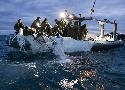
Feb. 12: Lake Huron
Location and altitude: The object was around 20,000 feet, soaring near the eastern portion of Michigan's Upper Peninsula. It was shot down over Lake Huron, "about 15 nautical miles east of the Upper Peninsula," VanHerck said.
Size and shape: "It presented as an octagonal structure with strings hanging off but no discernable payload," a senior Biden administration official said.
What shot it down: An F-16, firing an AIM-9X Sidewinder missile.
Feb. 11: Yukon, Canada
Location and altitude: Approximately 40,000 feet, in Canada's central Yukon, after crossing the border from Alaska. The shootdown took place around 100 miles from the U.S.-Canada line.
Size and shape: Early indications showed "this object is potentially similar" to the one shot down off the South Carolina coast, Canadian Defense Minister Anita Anand said, adding that it was "smaller in size and cylindrical."
What shot it down: An F-22 fired an AIM-9X Sidewinder missile, said Ryder, the Pentagon press secretary.
Feb. 10: Alaskan coast
Location and altitude: It was at 40,000 feet, over Prudhoe Bay along Alaska's northern coast.
Size and shape: "The object was about the size of a small car," Ryder told reporters, adding that it was "not similar in size or shape to the high-altitude surveillance balloon" from the previous weekend.
What shot it down: An F-22 fired an AIM-9X Sidewinder missile.
Feb. 4: South Carolina coast
Size and shape: The balloon was estimated to be up to 200 feet tall. Of the payload, VanHerck said, "I would categorize that as a jet airliner type of size, maybe a regional jet," with a weight of more than 2,000 pounds.
Location and altitude: The balloon famously crossed much of the continental U.S. before being shot down over the Atlantic Ocean, near Myrtle Beach, S.C. It was flying between 60,000 and 65,000 feet.
What shot it down: An F-22 Raptor using an AIM-9X Sidewinder missile.
Having come from the Pentagon, I can tell you that some of these UAPs, while we may not be able to know what each and every one is doing, some of the big concern there was that
a lot — not — many of those reports were happening around our training ranges, were happening around air training ranges. So combat pilots were seeing these things. And it was — and there was a potential impact to the safety of flight of our pilots. But you may not have but a fleeting moment on some of these things to see it. And so, it’s different.
In these cases, we had time to detect, time to analyze, time to engage, time to make those kinds of decisions. But it all comes down to safety and security, first and foremost.


“I was told for decades that Lockheed had some of these retrieved materials,” he said. “And I tried to get, as I recall, a classified approval by the Pentagon to have me go look at the stuff. They would not approve that. I don’t know what all the numbers were, what kind of classification it was, but they would not give that to me.” He told me that the Pentagon had not provided a reason. I asked if that was why he’d requested SAP status for AATIP. He said, “Yeah, that’s why I wanted them to take a look at it. But they wouldn’t give me the clearance.” (A representative of Lockheed Martin declined to comment for this article.)