32 private links
JWST spotted two sulfur‑bearing gases (DMS and DMDS) in the atmosphere of hycean exoplanet K2‑18 b (8.6 × Earth’s mass, 124 ly away), a combination that on Earth is made only by marine microbes—making this the strongest potential biosignature detected so far, though follow‑up observations are needed to rule out non‑biological sources.


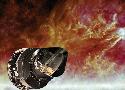
NASA's Spitzer Space telescope shows a collection of gas and dust over 500 light-years across, the Perseus Molecular Cloud, hosts an abundance of young stars.

As Barry “Butch” Wilmore and Suni Williams prepare to come home after their unexpected nine-month ISS stay, here is what they may experience
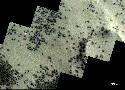
They're not actual spiders, of course, but rather strange geological features.
Researchers have demonstrated that cold atoms can be used to simulate gravitational waves in a laboratory setting. When two black holes collide, they send ripples through space and time, much like waves spreading across a pond. These ripples, known as gravitational waves, were first predicted by Ei

Scientists Researching Dark Matter May Have Found Evidence Of A New Type Of Particle » TwistedSifter
Discovering a new type of particle is always exciting.
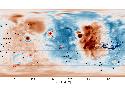
Gravity study gives insights into hidden features beneath lost ocean of Mars and rising Olympus Mons
Studies of gravity variations at Mars have revealed dense, large-scale structures hidden beneath the sediment layers of a lost ocean. The analysis, which combines models and data from multiple missions, also shows that active processes in the Martian mantle may be giving a boost to the largest volcano in the solar system, Olympus Mons.
"These dense structures could be volcanic in origin or could be compacted material due to ancient impacts. There are around 20 features of varying sizes that we have identified dotted around the area surrounding the north polar cap—one of which resembles the shape of a dog
Although volcanoes are very dense, the Tharsis area is much higher than the average surface of Mars, and is ringed by a region of comparatively weak gravity. This gravity anomaly is hard to explain by looking at differences in the Martian crust and upper mantle alone. The study by Dr. Root and his team suggests that a light mass around 1750 kilometers across and at a depth of 1100 kilometers is giving the entire Tharsis region a boost upwards. This could be explained by huge plume of lava, deep within the Martian interior, traveling up towards the surface.
If you travel far enough away from the Sun, the Solar System becomes a lot more populated.
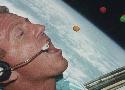
Spending time in space has all sorts of effects on astronauts.
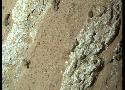
NASA's Perseverance rover has discovered an intriguing rock on Mars, named Cheyava Falls, showcasing potential signs of ancient life due to its unique chemical signatures and structural features. This finding, supported by the presence of organic compounds and distinct color patterns suggestive o
dark stars formed by dark atoms could end up becoming a dark galaxy invisibly superimposed on our own Milky Way

A new study provides some theoretical underpinning to sci-fi warp drives, suggesting that the superfast propulsion tech may not forever elude humanity.
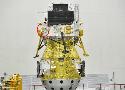
The mission has now entered lunar orbit but landing won’t be for a while.
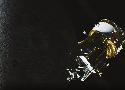
By retrieving rare volcanic samples from the lunar far side, Chang'e-6 aims to provide answers as to why volcanism was so limited on just one side of the moon.

The magical thinking is more apparent when you realize that it is believed that encountering the vastness of space will make humanity ultra-altruistic, while still being good capitalists. I have my doubts that this philosophy will work out well for anyone involved.
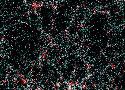
The discovery of this elusive force dates back to 1998 when astronomers found that the expansion of the universe is accelerating. The expansion itself was initially driven by the energy from the Big Bang, but since the Big Bang happened so long ago (13.8 billion years ago, to be exact), this expansion should be slowing down.
To make up for this conundrum, theorists postulated that some mysterious force, dark energy, must exist that acts against gravity and drives matter apart. Cosmological models show that dark energy accounts for 68% of all energy in the cosmos, according to NASA. But astronomers admit that the evidence for its existence is a bit vague.
"[The acceleration of the expansion] of the universe doesn't make sense when you think that there's just gravity there," Isobel Hook, a professor of astrophysics at Lancaster University in the U.K. and a Euclid scientist, told Space.com. "It shouldn't be slowing down. So the fact that we observe it getting faster means that there must be something else. And we just call that thing dark energy because we don't really know at all what it is."
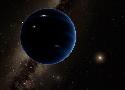
Planet Nine's existence was discovered by Konstantin Batygin and Mike Brown through mathematical modeling and computer simulations.
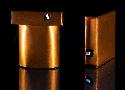
The Quantum Drive, which most physicists say is impossible, is getting ready for a real-world test in space this October.
Of course, he also notes that any thrust generated would be extremely small, so it would best be used for changing the orbits of satellites or for deep space missions where removing the need to carry fuel could dramatically change the distances they could travel.
"the flat universe remains the leading model of our cosmic surroundings"
Scientists think the universe is flat, but new observations suggest that we might actually be living in a gigantic sphere. Whoa.